 Watch Go Forth and Be a Blessing (opens the video)
Latest sermon
The Long Road
Shabbat Lech Lecha 5787
Congregation Sinai, October 2026
דרשות
Divrei Torah, drashot and sermons.
Sermons to watch
Watch Go Forth and Be a Blessing (opens the video)
Latest sermon
Shabbat Lech Lecha 5787
Congregation Sinai, October 2026
Shabbat Yitro · 2026
Shabbat Matot-Masei · 2025
Rosh Hashanah, second day · 2024
Sermons to read
Shabbat Lech Lecha · 2026
Shabbat Va’etchanan · 2026
Shabbat Yitro · 2026
Shabbat Toldot · 2025
Shabbat Matot-Masei · 2025
Shabbat Chayei Sarah · 2024
Rosh Hashanah, second day · 2024
Shabbat Chukat · 2024

Dana writes poems and song lyrics, tells stories and makes visual art. She is a rabbinical student at the Academy for Jewish Religion.
More about DanaShabbat Lech Lecha י״ג בחשוון תשפ״ז October 24, 2026
Be a blessing.
וֶהְיֵה בְּרָכָה
Eighteen years ago, at the end of October, my family arrived in California.
Two parents. Two children. Eight suitcases.
And the rest of our belongings in a shipping container crossing the ocean.
Our life, for a while, divided between what we could carry and what we trusted would follow.
We landed a week before Halloween.
Just like this week.
Imagine arriving from Israel, where war is never very far from your thoughts,
and finding your neighbors’ lawns full of skeletons, tombstones, and fake blood.
They saw a holiday.
I was still trying to understand the neighborhood.
We had reached our destination.
It took longer to understand what it meant to arrive.
Which brings me to this week’s parashah.
Lech lecha, Lechi lach.
Go forth.
God says to Avram: Go forth from your land, your birthplace, your father’s house—to the land that I will show you. · וַיֹּאמֶר ה׳ אֶל־אַבְרָם לֶךְ־לְךָ מֵאַרְצְךָ וּמִמּוֹלַדְתְּךָ וּמִבֵּית אָבִיךָ אֶל־הָאָרֶץ אֲשֶׁר אַרְאֶךָּ1
We know that verse so well.
But let me ask you something:
Who actually began the journey to Canaan?
We usually say, Avram.
But look one chapter earlier, at the end of Parashat Noach.
Terach, Avram’s father, sets out with the family from Ur Kasdim toward Canaan. They come as far as Harran, and settle there. · וַיֵּצְאוּ אִתָּם מֵאוּר כַּשְׂדִּים לָלֶכֶת אַרְצָה כְּנַעַן וַיָּבֹאוּ עַד־חָרָן וַיֵּשְׁבוּ שָׁם2
Wait. Canaan was already the destination.
The Torah tells us where Terach was going.
So why, when God speaks to Avram, does God say, the land that I will show you?
Why not simply say, Go to Canaan?
Perhaps because knowing the destination is not the same as
knowing what the journey will ask of us—or what it might make possible.
And God offers more than a destination.
In the next verse comes a promise: I will bless you.
And then: ve-heyeh bracha—Be a blessing. · וֶהְיֵה בְּרָכָה
No map.
But a promise.3
Is it a promise, or a charge?
I hear both.
Not a promise that every road will be easy—but an invitation to discover what the journey can bring into being.
That brings me to another question:
Why did Terach leave in the first place? The Torah never tells us directly.
We do know that he had lost a son, Haran—the father of Lot.4
Ramban describes the family’s fear of the king—in rabbinic tradition, Nimrod, a biblical ruler.5
Or HaChaim offers another possibility: Terach hoped that a change of place might make it possible for Avram and Sarai to have a child.6
Meshaneh makom, meshaneh mazal · מְשַׁנֶּה מָקוֹם, מְשַׁנֶּה מַזָּל
A change of place can change your fortune.
One interpretation hears danger behind the journey.
Another hears hope.
The Torah does not tell us what Terach felt.
But I imagine a father who had known loss and still tried to open a future for his family.
He never reached Canaan.
But the road he helped open did not end with him.
Perhaps that is true of many of our journeys. We may be moving away from something difficult,
or toward something hopeful. Often, both are true.
Rabbi Jonathan Sacks offered four ways to hear the words lech lecha.
Together, they describe something I recognize in every journey.7
Go for yourself.
Rashi hears a promise of growth: there is something you may become elsewhere that you cannot become here.
Go with yourself.
The Midrash compares Avram to a flask of fragrance. Move it, and its scent spreads.
We bring our music, our language, our food—and, in my case, the firm belief that breakfast should include a salad.8
Go to yourself—a new place can show us a part of ourselves we did not yet know.
Go by yourself—the courage to take a first step before anyone else can see where it leads.
Four ways of moving.
And most of us travel in more than one at once.
Knowing the destination is not the same as knowing what the journey will ask of us.
That last one, courage, brings me to my great-grandmother, Savta Rabba Chava.
More than a century ago, before there was a State of Israel, she left Poland for Canaan, with my great-grandfather and nine of their ten children.
She went toward the Land.
My father and his family followed her from Poland.
And I?
I went in the other direction.
Did I really go in the other direction?
I love the home we have made here.
And Israel remains part of me: Tel Aviv, the sea, the cafés, life lived outdoors.
Hebrew—not simply a language, but an entire culture of humor, music, argument, and memory.
Shlomi Shaban, an acclaimed songwriter, has a song called Canaan, whose refrain keeps returning to one line: the road to Canaan is a long one.
אני רק יהודי נודד
נולדתי כדי להיפרד
מקדמת דנא ועד לשנה הבאה בירושלים
זאת דרך ארוכה, זאת דרך ארוכה, לכנען
“I’m just a wandering Jew
I was born to say goodbye
Ever since then until next year in Jerusalem”
It is a long road, a very long road; it is a long road to Canaan
The iCenter9
I hear that refrain and find myself asking:
Toward Canaan? Or from Canaan?
The answer, I suspect, is not always found on a map.
Houses stay behind. What travels with us are the people.
This Shabbat was my mother’s yahrzeit, ten years since her death.
She left Romania with her parents, and she carried it with her in her voice: all her life, the throaty Hebrew ch came out as a soft Romanian h.
A few weeks ago, my sister visited Romania with her family and sent me a photograph of them standing in front of the house where my mother once lived. Another family lives there now.
The house belongs to someone else’s present.
It is still part of our family’s story.
Houses stay behind. What travels with us are the people.
And perhaps that is why I love one small detail in the Torah’s account of Avram and Sarai leaving Harran.
It tells us that they took their possessions—and then adds:
The souls they had made in Harran. · וְאֶת־הַנֶּפֶשׁ אֲשֶׁר־עָשׂוּ בְחָרָן10
Rashi understands these as people Avram and Sarai brought close to the Divine Presence.
They were not simply moving things from one place to another. They had built relationships.11
Relationships are one way a new place begins to feel like home.
We walk on roads others helped to build.
That is why I believe this call is not only for people who cross oceans.
It is for anyone learning a new language, beginning a new chapter, taking on a responsibility, or reaching across the distance to another human being.
All of these are journeys.
And none of us begins entirely alone.
We walk on roads others helped to build.
Those before us laid stones—some with courage,
some with hope, some carrying burdens we may never fully know.
Savta Rabba Chava laid hers.
My parents laid theirs.
Now it is my turn, ours.
We place our stones,
for ourselves and for those who will come after us.
Our children, and their children, will add theirs.
We cannot see every turn their road will take. But we can make something possible for them.
So here is a question to take into Shabbat:
Where might your own lech lecha be asking you to move?
Not necessarily across a continent.
Perhaps toward one honest conversation, one brave decision, or one step beyond what is familiar.
And at kiddush, ask someone about a journey they have taken.
Share a little of yours. There may be more roads in this room than we imagine.
God did not give Avram a map.
God gave him a promise:
Ve-heyeh bracha. Be a blessing.
Perhaps the blessing is not only waiting at the destination.
Perhaps it begins in the walking—and in what becomes possible for someone else because we walked.
May these words honor my mother’s memory,
and all those who laid stones before us—so that we, our children, and our children’s children may keep walking.
Lech lecha, Lechi lach.
Go forth.
Ve-heyeh, Ve-hiyi bracha.
Be a blessing.
Shabbat Shalom · שבת שלום
This sermon was delivered at Congregation Sinai, San Jose, CA.
Shabbat Va’etchanan י״א באב תשפ״ו July 25, 2026
מִנֶּגֶד
רחל · לחן: דנה גריצר
קַשּׁוּב הַלֵּב. הָאֹזֶן קַשֶּׁבֶת:
הֲבָא? הֲיָבוֹא?
בְּכָל צִפִּיָּה
יֵשׁ עֶצֶב נְבוֹ.
זֶה מוּל זֶה – הַחוֹפִים הַשְּׁנַיִם
שֶׁל נַחַל אֶחָד.
צוּר הַגְּזֵרָה:
רְחוֹקִים לָעַד.
פָּרֹשׂ כַּפַּיִם. רָאֹה מִנֶּגֶד
שָׁמָּה – אֵין בָּא,
אִישׁ וּנְבוֹ לוֹ
עַל אֶרֶץ רַבָּה.
חורף, תר״ץ
From Afar
Rachel Bluwstein · Melody: Dana Greitzer
Translation: Ofra Arieli Backenroth
Attentive the heart. The ear listening:
Is anyone coming?
Every expectation contains
the sadness of Nevo.
One facing the other—two shores
Of a single river.
The rock of fate:
Ever far apart.
Spread your wings. See from afar
There—no one is coming,
To each his own Nevo
In a land of plenty.1
Rachel Bluwstein—known to generations of Israelis simply as Rachel—was one of the most beloved voices of modern Hebrew poetry. She found a home near the Kinneret and at Degania, but tuberculosis forced her to leave the landscape and the life she loved.
In Mineged—From Afar—Moses’ Mount Nevo (Nebo) becomes her Nevo, and then it becomes ours:
Every expectation contains the sadness of Nevo.2
Nevo is the place from which we can see a beloved future while knowing that we may never enter it.
What does Va’etchanan mean?
It means:
I pleaded.
I implored.
I asked for grace. · הִפְצַרְתִּי. בִּקַּשְׁתִּי חֶסֶד
Rashi reads va’etchanan as a request for matnat chinam—a freely given gift, not a reward.3
Even Moses does not stand before God and say: After everything I have done, I deserve this.
He says:
Please.
Let me cross over.
Let me see the good land. · אֶעְבְּרָה־נָּא וְאֶרְאֶה אֶת־הָאָרֶץ הַטּוֹבָה אֲשֶׁר בְּעֵבֶר הַיַּרְדֵּן4
When I read Va’etchanan, I do not first see Moses the great lawgiver.
I see a person.
A person praying, pleading, wanting to touch the dream to which he has given his life.
Moses does not hide his longing. He allows himself to be vulnerable before God.
Professor Rachel Elior describes the first-person voice of Deuteronomy as the first autobiography in Hebrew literature. Moses tells us his own story:5
I pleaded.
I wanted.
I was refused.
At the end of his life, he chooses what must be remembered, what must be taught, and what must continue after him.
Moses does not hide his longing. He allows himself to be vulnerable before God.
Not long ago, I sat with a student who was troubled by this story.
It’s not fair, he said.
Moses had led the people for forty years and brought them almost to the destination. The student compared it to working hard in school or at a job, doing everything you can to move forward—and then being told that you cannot take the next step.
And I understood him.
It does feel unfair.
Our tradition offers different explanations for why Moses did not enter the land: some focus on the rock, some on his anger, and some suggest that a new generation required a different kind of leader.6
But today, the precise explanation matters less to me than the human reality: Moses has given his life to a journey he will not be allowed to complete.
So the question that matters most to me is:
What does Moses do when the future he desired is no longer in his hands?
For each of us, there is a Jordan we will not cross.
The parashah begins with Va’etchanan—I pleaded.
And it moves toward Shema Yisrael—Hear, O Israel. · שְׁמַע יִשְׂרָאֵל, ה׳ אֱלֹהֵינוּ, ה׳ אֶחָד7
Moses cannot determine the final chapter of his own life. But something is still in his hands.
God tells him to strengthen Joshua, give him courage, and prepare him to lead the people across. · וְצַו אֶת־יְהוֹשֻׁעַ וְחַזְּקֵהוּ וְאַמְּצֵהוּ8
Instead of pouring his remaining strength into his own commemoration, Moses pours it into what Elior calls a community of memory.9
He does not ask the people to build him a monument. He asks them to remember the covenant, to learn, to teach, and to carry the story forward.
Rabbi Jonathan Sacks writes:
For each of us, there is a Jordan we will not cross, however long we live, however far we travel.10
Human life is always unfinished.
Moses will not cross, but Joshua will. What Moses begins, others will carry forward because he has strengthened and prepared them.
This is where the Shema becomes the heart of Moses’ response to his own mortality.
Elior reads this parashah as the creation of a culture not primarily of the eye, but of the ear, the word, and the book.11
Recalling Sinai, Moses reminds the people:
You heard the sound of words but perceived no shape—nothing but a voice. · קוֹל דְּבָרִים אַתֶּם שֹׁמְעִים וּתְמוּנָה אֵינְכֶם רֹאִים זוּלָתִי קוֹל12
The God of Israel cannot be frozen into an image or contained in a monument.
God is encountered through address and response: God speaks; Israel hears, remembers, loves, and acts.
Words become the bridge between the invisible, eternal God and mortal human beings.13
Words can carry what no statue can: justice, freedom, compassion, memory, covenant, and hope.
So Shema does not mean only: hear a sound.
And it does not mean only: believe that God is one.
It means:
Make yourself available to the divine voice.
Allow what you hear to enter your heart
and shape the way you live.
Then Moses turns hearing into continuity:
Place these words upon your heart. · וְהָיוּ הַדְּבָרִים הָאֵלֶּה אֲשֶׁר אָנֹכִי מְצַוְּךָ הַיּוֹם עַל־לְבָבֶךָ14
Teach them to your children. · וְשִׁנַּנְתָּם לְבָנֶיךָ
Speak of them at home and on the road, · וְדִבַּרְתָּ בָּם, בְּשִׁבְתְּךָ בְּבֵיתֶךָ וּבְלֶכְתְּךָ בַדֶּרֶךְ
when you lie down and when you rise. · וּבְשָׁכְבְּךָ וּבְקוּמֶךָ15
The covenant will not be preserved in Moses’ body or in a monument built in his honor. It will be carried in language, memory, learning, love, and daily practice.
That is why it can outlive Moses, cross the Jordan without him, survive exile, and remain alive wherever Jews live.
So Moses strengthens Joshua.
He teaches the people.
He gives them words to place upon their hearts and to pass on to their children.
He cannot control his own ending, but he can help shape the life that will continue after him.
Words can carry what no statue can.
This is the movement of the parashah: from the solitary I to the covenantal we.
And this is the message that speaks most deeply to me:
Not everything is in our hands.
But the transmission is.
It is in our hands to teach, to strengthen, to bless, and to pass forward what we have received. And it is in our hands not alone, but together.
To each their own Nevo—a dream we can see but not fully reach.
But we do not stand there only to mourn. We also ask:
What can I pass forward?
Whom can I strengthen?
What can we carry together?
I think of my student. He was right: it is not fair. And still, what we pass on remains in our hands.
Our greatness may not lie in crossing every river ourselves.
It may lie in helping one another cross—and in trusting that what we teach, what we love, and what we begin can continue beyond the horizon of our own lives.
פָּרֹשׂ כַּפַּיִם. רָאֹה מִנֶּגֶד
שָׁמָּה — אֵין בָּא,
אִישׁ וּנְבוֹ לוֹ
עַל אֶרֶץ רַבָּה.Spread your wings. See from afar
There—no one is coming,
To each his own Nevo
In a land of plenty.16
Shabbat Shalom · שבת שלום
This sermon was delivered at Congregation Sinai, San Jose, CA.
Shabbat Yitro כ׳ בשבט תשפ״ו February 7, 2026
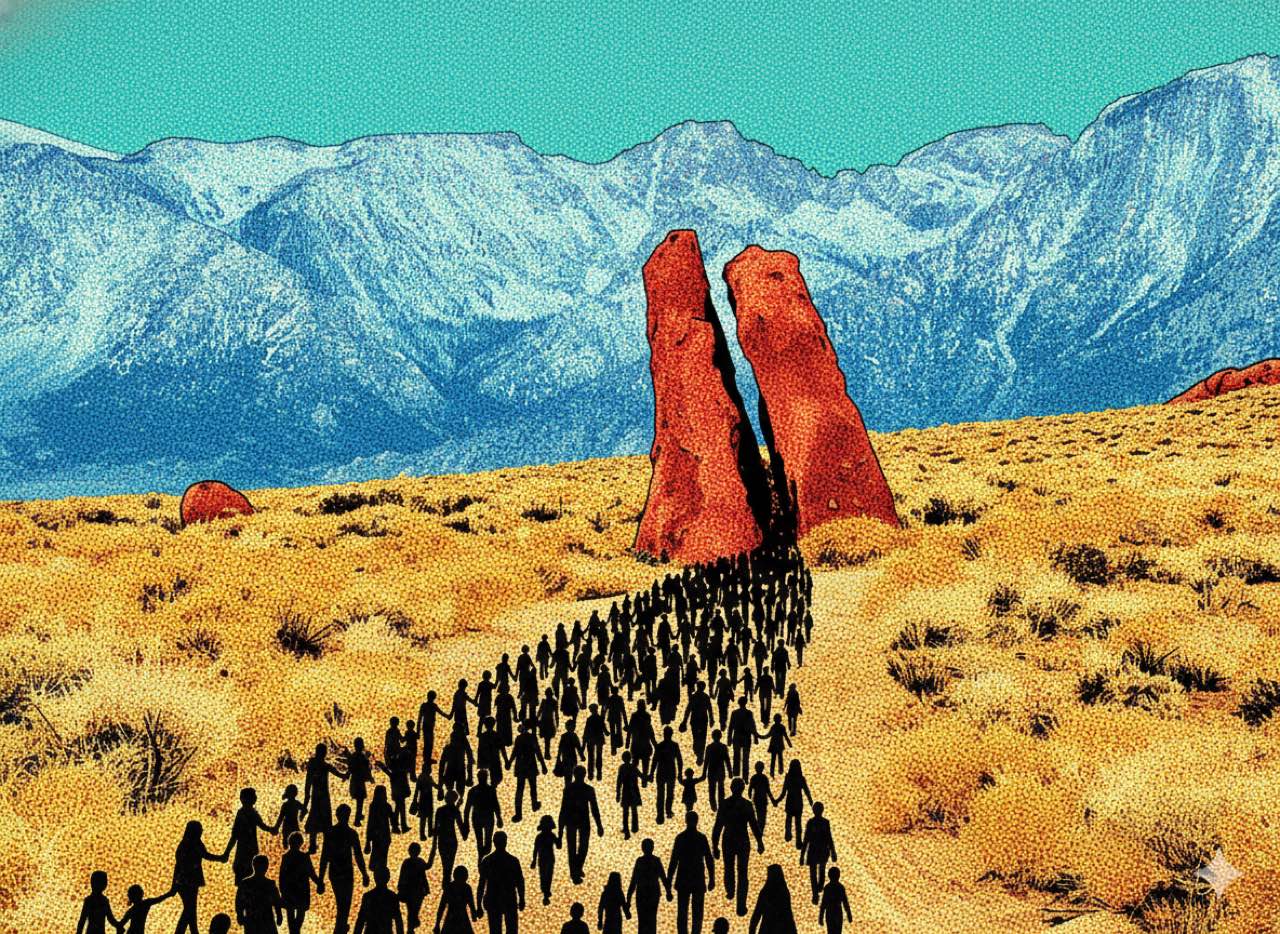
Imagine waking up in your tent, free from the chains of slavery in Egypt, only to find yourself in an endless, motionless line. This is the “Great Standstill”: the moment we realized that freedom requires more than the absence of oppression; it requires actively taking control of destiny, building a solid structure, and pouring soul into it.
I find my inspiration in a poem by the Israeli poet Amir Gilboa, written in 1953 (and later famously performed by Shlomo Artzi). It is a song that has become an anthem of Jewish resilience:
פִּתְאֹם קָם אָדָם בַּבֹּקֶר וּמַרְגִּישׁ כִּי הוּא עַם וּמַתְחִיל לָלֶכֶת,
וּלְכָל הַנִּפְגָּשׁ בְּדַרְכּוֹ קוֹרֵא הוּא שָׁלוֹם.
Suddenly, a person wakes up in the morning, feels he is a nation, and starts walking, and to everyone on his path, he calls out: ‘Shalom’.
This poem was born from a pivotal moment in history, the poet’s encounter with Holocaust survivors searching for lost family members and friends after World War II. They were lonely, broken individuals seeking to find their way back to becoming a “people” again.
I find myself coming back to this verse again and again: How does that “feeling” happen? How does someone, waking up in their private tent, suddenly feel like a “Nation”?
Imagine Moses on the morning after the Exodus. He has achieved what political philosophy calls Negative Liberty—the freedom from Pharaoh, from slavery. But as he wakes up in the desert, he discovers that there is no movement in this liberation. Instead, he is stuck in a state of stagnation. The Torah describes this (Exodus 18:13):
Next day, Moses sat as magistrate among the people, while the people stood about Moses from morning until evening.
וַֽיְהִי֙ מִֽמׇּחֳרָ֔ת וַיֵּ֥שֶׁב מֹשֶׁ֖ה לִשְׁפֹּ֣ט אֶת־הָעָ֑ם וַיַּעֲמֹ֤ד הָעָם֙ עַל־מֹשֶׁ֔ה מִן־הַבֹּקֶר עַד־הָעָֽרֶב
Ruth Zielenziger, in her book “Exodus: A Teacher’s Guide”, highlights this exact moment. Moses is a singular “I,” and the people are a passive “Mass.” They are waiting in an endless line for one leader to decide everything. They are free from slavery, but they have not yet begun “to walk” as a nation. They are still a collection of individuals waiting to be shaped into something new.
Yitro steps into this scene as an outsider. The commentator Amos Hakham notes that this encounter is the essential preparation for the Covenant at Sinai. Why? Because Yitro brings the “Human Wisdom” necessary to build a sense of “We,” of connectedness.
He asks Moses: Why do you act alone as judge, with all the people standing about you from morning until evening? (18:14). Yitro understands that a people cannot be built on the shoulders of one man. If the people only relate to the leader, they are not a nation; they are a crowd. Yitro suggests a structure (18:21):
Chiefs of thousands, hundreds, fifties, and tens.
שָׂרֵ֤י אֲלָפִים֙ שָׂרֵ֣י מֵא֔וֹת שָׂרֵ֥י חֲמִשִּׁ֖ים וְשָׂרֵ֥י עֲשָׂרֹֽת
This is the first component of becoming a nation: establishing the first judicial and social organization. But it’s not just about logistics. By creating these units, Yitro ensures that every individual is seen. In a crowd of six hundred thousand, you are anonymous. But in a group of ten, you have a name, a voice, and a neighbor.
In this moment, the “Person” begins to become a “People.” The organization creates the sense of “We” by making every “I” matter. We move from Negative-Liberty to Positive-Liberty, the freedom to actively take responsibility. A person becomes a “People” the moment they stop standing in line and start walking alongside others.
But a structure alone, even the most perfect one, is just a skeleton. If Yitro’s help in organization gave us the rules of engagement—the basic ‘How’ of living together—then Sinai gives us the vision of holiness—the ‘Why.’ It is no longer a chaotic crowd but a structured community; they are finally ready for the Revelation at Sinai. The Covenant is the moment the ‘We’ finds its soul. It is the realization that we didn’t organize ourselves just to be more efficient, but to be more human, and more holy.
At the foot of the mountain, the ‘We’ that was built through shared responsibility enters into a deeper commitment. It is only here, through the Revelation and the receiving of the Tablets, that the ״we״ truly move from being a group of refugees to being a Nation עם: a community bound not just by a system of chiefs and judges, but by a shared heartbeat and a mission. Yitro provided the ground for us to stand on, but the Covenant provided the vision that finally made us start walking together.
Amir Gilboa’s poem concludes by linking that ancient desert journey to our lives here today:
And he laughs with the strength of generations from the mountains, and the wars bow down in shame, to the glory of a thousand years flowing in the depths, a thousand young years are before him – like a cool stream, like a shepherd’s song, like a branch.
וְהוּא צוֹחֵק גְּבוּרַת דּוֹרוֹת מִן הֶהָּרִים וְנִכְלָמוֹת מִשְׁתַּחֲווֹת הַמִּלְחָמוֹת אַפַּיִם
לְהוֹד אֶלֶף שָׁנִים מְפַכּוֹת בַּמִסְתָּרִים, אֶלֶף שָׁנִים צְעִירוֹת לְפָנָי
כְּפֶלֶג צוֹנֵן, כְּשִׁיר רוֹעִים, כְּעָנָף
The “Strength of Generations” is the ability to maintain both components: the organization that holds us together and the Covenant that gives us life. Thousands of years later, this community still implements the architecture Yitro envisioned. Every board meeting, every volunteer shift, every phone call to a neighbor is the “Organization” that makes the “Covenant” possible. You are the “chiefs of hundreds” and the “chiefs of tens.”
Our engagement is the vessel; the Torah is the light. When we carry our share of the Public Duty, we are no longer lonely individuals lost in the wilderness. We wake up in the morning, we see the faces of our community, we remember our Covenant, and together…
We continue to walk.
First published on The Times of Israel blogs.
All sermonsShabbat Toldot ב׳ בכסלו תשפ״ו November 22, 2025
What if Rebecca’s struggle with Jacob and Esau isn’t only about two ancient brothers, but about the tension between “field and tent,” space and time, inside each of us? On parenting, labels, Shabbat, and building small “tents of time” where coexistence is actually practiced.
I want to start not with an idea, but with a body.
Rebecca’s body.
After years of praying and hoping, she finally conceives. I imagine she wants what so many want after long seasons of longing: a chance at normalcy. To carry a pregnancy. To give birth. To raise children. To settle into a life that is not constantly dramatic.
But the Torah does not offer her that relief. Almost immediately, we read:
“וַיִּתְרֹצְצוּ הַבָּנִים בְּקִרְבָּהּ – But the children struggled in her womb”. Not kicked—struggled. Not fluttered—collided. It feels to her less like “I’m pregnant,” and more like “There is a battle inside me.” Out of that collision comes one of the most haunting, compact cries in the Torah:
“אִם־כֵּן לָמָּה זֶּה אָנֹכִי – If (it be) so, why do I exist?”
Rashi hears regret: If this is my pregnancy, why did I pray for it? Ramban hears something closer to existential despair: If this is my life, what is the purpose of ‘me’?
But what moves me most is what Rebecca does next: וַתֵּלֶךְ לִדְרֹשׁ אֶת־ה׳ – She went to inquire of the God.” She refuses to resign. She searches for meaning. What she gets is not comfort, but knowledge, yediʿah:
Two nations are in your womb. Two separate peoples shall issue from your body; One people shall be mightier than the other. And the older shall serve the younger.
This is more than a pregnancy. It is a prophecy of divergence, imbalance, and conflict. She learns she is not only becoming a mother; she is becoming a bridge—and perhaps a fault line—between two worlds.
Rebecca’s question, “Lamah zeh anochi – If so, why do I exist?”, comes not only from physical pain, but from the weight of knowing what lies ahead—and from wondering what it means to be the mother of both.
Not a Good Child and a Bad Child
When the twins grow up, the Torah paints them in bold strokes: “Esau became a skillful hunter, a man of the outdoors; but Jacob became a mild man, raising livestock.” (dwelling in tents) (Gen. 25:27).
It is tempting to read this as a moral verdict:
Esau is wild, Jacob is gentle. Esau is bad, Jacob is good.
Some midrashim support that: one baby drawn to idolatry, the other to Torah—already in the womb. You can almost picture it: One baby lunging for the Beit Midrash (Study house), the other is trying to get to… pretty much anywhere else.
But our tradition is not monolithic. One later commentator insists:
“אֵין אָדָם נוֹלָד רָשָׁע אוֹ צַדִּיק – A person is not born wicked or righteous.”
He reads “two nations in your womb” as describing peoples and histories, not baby souls stamped forever as “good kid / bad kid.”
Malbim, for example, sees Jacob and Esau as different modes of existence—matter and form, body and soul, outwardness and inwardness. From this point of view, Rebecca is not carrying a hero and a villain. She is holding two essential forces of human life.
Even the oracle itself is more fluid than we might think.
On the verse: “וְרַב יַעֲבֹד צָעִיר – And the older shall serve the younger”, Chizkuni reads it conditionally: If Jacob and his descendants live up to their calling, the elder will serve the younger; If not, the relationship can flip, and Jacob may find himself under Esau’s yoke.
Already here, the prophecy is not a frozen script. There is room for failure, for growth—and maybe for some kind of shared life.
Rebecca’s question starts to sound different:
If I am mother to both of these forces, what does that ask of me?
Abraham Joshua Heschel gives us language to think about all this. In his book The Sabbath, he writes that modern civilization is obsessed with space—building, owning, controlling, and expanding. Not evil, just incomplete.
Judaism, he argues, sanctifies time. Shabbat is an “architecture of time,” a reminder that life is not ultimately about possession but about presence; not about controlling but about sharing; not about having but about being.
Read through Heschel, the verse shifts:
Esau, a man of the field, “of the outdoors – אִישׁ שָׂדֶה” a man of space.
Jacob, “a mild man” dwelling in tents, “יֹשֵׁב אֹהָלִים” a man of time.
“וְרַב יַעֲבֹד צָעִיר- the older shall serve the younger,” Becomes more than a family drama. It can be heard as a spiritual aspiration:
That the world of space—work, money, buildings, institutions, might one day serve the world of time—learning, relationship, prayer, justice. Not the erasure of Esau, but his integration. Not the destruction of the field, but its harnessing in service of the tent.
Most of us are not carrying literal nations.
But many of us live with a version of this duality inside:
The world of space: deadlines, ambition, careers, productivity, security.
The world of time: Shabbat, relationships, community, meaning.
Like Rebecca, we know a lot. We know how heavy the future feels—politically, socially, environmentally, spiritually. Our foreknowledge can feel more like a burden than a gift. And a quiet version of Rebecca’s question rises in us:
If this is the world my children are inheriting… why am I?
What is my task in a time like this?
One answer, for me, is that we build “tents of time.”
Every time we gather, sing together, or simply pause and bless, we push back—gently—against a culture obsessed with more and faster. We make small sanctuaries where Jacob’s world can breathe.
In those moments, we refuse to reduce each other to labels: “more religious,” “less religious,” “good kid,” “problem kid.” We honor the truth that each of us carries Jacob and Esau—time and space—within.
Rebecca’s question becomes ours: If these forces struggle, what is my role? Am I just a vessel for history, or do I help shape it?
Perhaps our work is to build places where the world of space begins to serve the world of time. Strength is used for justice. Ambition fuels compassion; Our identities are not frozen in a single story.
Places where the forces inside us learn, not only to struggle, but at least sometimes, to live side by side.
And that, too, is a way of answering:
“אם כן, למה זה אנכי – If so, why am I?”
So that, between space and time, we can help the two nations within us – and between us – move, even a little, toward coexistence.
First published on The Times of Israel blogs.
All sermonsShabbat Matot-Masei א׳ באב תשפ״ה July 26, 2025

Parashat Matot-Masei presents us with profound themes of collective responsibility, military service, and Jewish unity, just before the Israelites enter the Land of Israel. Before diving into the parashah, I want to ask a simple yet profound question:
Who bears the responsibility for protecting Israel?
Who bears the responsibility for safeguarding the Jewish people?
Is it the responsibility of soldiers alone?
The government of Israel?
Or perhaps… ours too—those of us sitting here today, in the Diaspora? And if it is our responsibility as well, how is it expressed?
In words?
In actions?
In a sense of belonging?
Are we just watching from afar?
Or are we, like the tribes of Reuben and Gad, also crossing the Jordan River on our way to Israel to be part of the front lines during times of war?
Among the many themes in this parashah, we find the tribes of Reuben and Gad requesting to settle on the eastern side of the Jordan River. Moses rebukes them sharply, saying, “Shall your brothers go to war while you sit here? – הַאַחֵיכֶם יָבֹאוּ לַמִּלְחָמָה וְאַתֶּם תֵּשְׁבוּ פֹה?
In other words, how can they leave their siblings behind and rest safely, tending to their cattle, while everyone else goes to war?
Military service is not the domain of select tribes or groups.
Even the tribe of Levi, dedicated to sacred service, was not exempt from this requirement.
Moses’ criticism emphasizes a central principle: The participation and responsibility of all parts of the nation in our shared security and survival. The demand for justice and equal burden-sharing in military service is directly reflected in the command: “And we will hasten as shock-troops in the van of the Israelites until we have established them in their home, while our children stay in the fortified towns because of the inhabitants of the land: We will not return to our homes until the Israelites; every one of them; are in possession of their portion. But we will not have a share with them in the territory beyond the Jordan, for we have received our share on the east side of the Jordan.” (Num. 32:17-19)
The parashah teaches us another crucial principle:
Military service is not the domain of select tribes or groups.
Even the tribe of Levi, dedicated to sacred service, was not exempt from this requirement. As it is written:
“You shall dispatch on the campaign a thousand from every one of the tribes of Israel.” אֶ֚לֶף לַמַּטֶּ֔ה אֶ֖לֶף לַמַּטֶּ֑ה לְכֹל֙ מַטּ֣וֹת יִשְׂרָאֵ֔ל תִּשְׁלְח֖וּ לַצָּבָֽא׃ (Numbers 31:4).
And as Rashi elaborates: ‘From all the tribes of Israel’—including, therefore, the tribe of Levi”.
Today, the State of Israel continues to grapple with this fundamental question: how to balance social justice and an equitable distribution of national responsibilities. The issue of not having all factions of the Israeli society shoulder the responsibility of military service, for example, is a modern expression of this ancient tension, as the Levite. Just as Moses demanded in his time, we too must demand that everyone take part in this responsibility, contributing according to their ability.
Zionism is not a political movement—it reflects a profound Jewish faith in shared responsibility
Yet the parashah teaches us another important lesson: the unity of Israel does not depend solely on those within the land but also on those who choose to live beyond its borders. The tribes of Reuben and Gad ultimately agree to send their warriors into battle alongside their brothers,
We, the Jews of the Diaspora, must also ask ourselves: how, like Reuben and Gad who lived beyond the physical boundaries of Israel, are we engaging with and sharing in this responsibility?
Today, following the events of October 7th, we have a deep understanding of the heavy cost and the crucial importance of Jewish unity and Zionism as a profound spiritual value. Zionism is not a political movement; it reflects a profound Jewish faith in shared responsibility.
Moses’ challenge is still relevant:
We must not leave our siblings to fight alone.
We must not leave the Land of Israel to others.
We must not leave the responsibility for the survival of the Jewish people to just one segment of us.
Only through unity and shared responsibility can we realize the vision of Torah and Zionism.
I want to conclude by returning to the word that begins our parashah: “Matot.” This word has multiple meanings: a staff, a tribe, and the verb “to incline” or “to shift,” meaning to change the balance or to influence the outcome.
This is not just an address about an ancient parashah; it is a call to take responsibility in our own time.
Indeed, the two-and-a-half tribes shifted the balance; they turned a situation of critique and even anger toward them into one of appreciation and understanding. They showed that it is possible to sit outside the physical borders of the Land of Israel and still be deeply and fully part of the collective responsibility of the Jewish people.
This week falls within the period of “Bein HaMetzarim”, the Three Weeks between the 17th of Tammuz and the 9th of Av, a time of national introspection and remembrance of destruction. The Haftarah from Jeremiah, which begins with the words “Hear the word of GOD – שמעו דבר ה׳”, continues with a warning about forgetting God, reminding us that destruction did not start from the outside; it started from within, when we lost our sense of mutual partnership and covenant.
This is not just an address about an ancient parashah; it is a call to take responsibility in our own time.
Amid mourning,
Amid the struggle,
Amid our complicated reality, we can and must shift the balance.
In these days of sorrow, we build hope.
And in brokenness, we choose covenant again!
Matot-Masei Sermon. Sinai Congregation of SJ, CA.
First published on The Times of Israel blogs.
All sermonsShabbat Chayei Sarah כ״ב בחשון תשפ״ה November 23, 2024

Our Torah portion, Chayei Sarah—חַיֵּי שָׂרָה—The Life of Sarah, begins with an unexpected twist: not with her life, but with an announcement of her death:
וַיִּהְיוּ֙ חַיֵּ֣י שָׂרָ֔ה מֵאָ֥ה שָׁנָ֛ה וְעֶשְׂרִ֥ים שָׁנָ֖ה וְשֶׁ֣בַע שָׁנִ֑ים שְׁנֵ֖י חַיֵּ֥י שָׂרָֽה׃ |וַתָּ֣מת שָׂרָ֗ה… וַיָּבֹא֙ אַבְרָהָ֔ם לִסְפֹּ֥ד לְשָׂרָ֖ה וְלִבְכֹּתָֽהּ׃ (Genesis 23:1)
What can we learn about Sarah’s life from a story that begins with her death, and how do we reconcile this paradox?
For much of my life, I struggled to connect with Sarah Imenu, our matriarch. She often seemed passive and overshadowed by Abraham, with her beauty highlighted but her voice and agency absent.
A portion titled “The Life of Sarah” opens with her passing—a contradiction that goes beyond literary tension, inviting us to reflect on what life truly means and how it is remembered.
For much of my life, I struggled to connect with Sarah Imenu, our matriarch. She often seemed passive and overshadowed by Abraham, with her beauty highlighted but her voice and agency absent. “Now I know what a beautiful woman you are” (Gen. 12:11). Her actions, like her treatment of Hagar, often felt harsh, and her abrupt death left her story feeling incomplete.
In her poem “The Life of Sarah: Summery”(Ynet), Dr. Ruhama Weiss, an Israeli scholar and poet, captures Sarah’s life through a list of clipped, passive verbs to reflect her lack of control over her own story:
Married / barren / taken on a journey / taken on another journey / taken on yet another journey / beautiful / desired / given to Pharaoh / returned with her husband (and with wealth) / barren / gave her maidservant to her husband / her maidservant conceived / tormented her maidservant / taken on another journey / received a promise / laughed (denied) / given to the king of Gerar / returned with her husband (and with wealth) / gave birth / banished her maidservant / died. (Translation assisted by AI tools.)
The poem reads almost like a checklist, a detached summary of a life lived in the shadow of others’ decisions. Even in the moments where Sarah acts—such as giving Hagar to Abraham or later expelling her—her actions come across as reactive, shaped by the pressures of her circumstances. She is constantly taken—taken by Pharaoh, taken by Avimelech, taken on endless journeys.
Her question stayed with me. It echoed my struggles and prompted me to dig deeper.
Last year, I heard this frustration again from a student as I was preparing her for her bat mitzvah Sermon. She wrote: “When I learned this was my Parasha, I was excited. I wanted to learn about Sarah’s accomplishments. But when I read it, I was disappointed. Her whole life is summed up in one sentence—her age when she died. So why is it called Chayei Sarah at all?”
Her question stayed with me. It echoed my struggles and prompted me to dig deeper. What is Sarah’s life? And why does this Parashah carry her name?
Like her, I navigate a world of rigid structures, and like her, I strive to assert my voice within those boundaries.
My perspective shifted when I took Rabbi Jill Hammer’s course on Women in the Torah through midrash at AJR, NY. Midrash—the art of filling gaps and amplifying voices—and discovered a new Sarah. Midrash doesn’t just explain the text; it reimagines it, breathing life into its silences.
Let me share three midrashim that transformed my understanding of Sarah:
These Midrashim reframe Sarah as a woman of prophetic vision, moral courage, and intellectual leadership. She shapes her own destiny while playing a pivotal role in the Jewish people’s legacy.
Sarah is no longer a figure to resist but one to connect with. Like her, I navigate a world of rigid structures, and like her, I strive to assert my voice within those boundaries. Through the Midrashim about Sarah, I’ve understood the power of reinterpretation—the ability to revisit and reshape the stories that define us.
To my students and all of us wrestling with these sacred texts, I offer this: Sarah’s life is not bound by the words on the page. Her legacy lives in the midrash, amplifying her voice and how we see her anew.
May her life inspire us to seek meaning beyond the surface, to amplify silenced voices, and to find the courage to reshape our narratives with wisdom and resilience.
In a way, we are all Sarah.
First published on The Times of Israel blogs.
All sermonsRosh Hashanah, second day ב׳ בתשרי תשפ״ה October 4, 2024
Next year, we’ll sit on the porch and count migrating birds
בַּשָּׁנָה הַבָּאָה נֵשֵׁב עַל הַמִּרְפֶּסֶת וְנִסְפֹּר צִפּוֹרִים נוֹדְדוֹת
These iconic words from Bashana Haba’a, written by Ehud Manor and composed by Nurit Hirsh, capture a timeless dream of hope, peace, and renewal. First released in 1970, during a period of political uncertainty in Israel, the song’s gentle optimism has resonated for decades. With imagery of children playing, grapes ripening, and birds migrating, Bashana Haba’a paints a picture of a better tomorrow—a vision we all share. The chorus, “You’ll see how good it will be next year – עוֹד תִּרְאֶה, עוֹד תִּרְאֶה כַּמָּה טוֹב יִהְיֶה reflects a collective hope for a brighter future filled with peace and stability.
But the beauty of this song runs deeper than its poetic imagery. Released after the Six-Day War (מִלְחֶמֶת שֵׁשֶׁת הַיָּמִים) in 1967, Bashana Haba’a came at a time when Israel was facing immense challenges, including governing new territories and enduring the War of Attrition, grappling with loss and uncertainty to this day. Yet the song stood as a beacon of hope, offering a belief that better days would come.
Being Jewish is not just about observance or ritual. It’s about a Shared History, a shared culture, and a shared ancestral homeland—a peoplehood and a nation (Noa Tishbi)
But it’s not just about individual hope. As Noa Tishby explains in her book Uncomfortable Conversations with a Jew, “Being Jewish is not just about observance or ritual. It’s about a Shared History, a shared culture, and a shared ancestral homeland—a peoplehood and a nation“. This shared connection ties back to the Book of Numbers בַּמִּדְבָּר, where the Israelites transitioned from wanderers to a unified nation bound by a covenant with God, each other, and the land of Israel.
Today, in the face of new challenges, we ask similar questions. October 7th was a wake-up call highlighting how deeply interconnected we are as Jewish. As Tishby says, “As a community, we had to put our mourning and grief on pause to combat the surge of anti-Jewish hate.” This difficult time has reminded us that self-reflection is not just about individual growth but also about understanding our collective role in the larger Jewish story. Have we done enough to engage with the issues of our time? Have we stood up against antisemetism, for each other, and Israel?
What have we done to uphold our Jewish identity?
Rabbi Jonathan Sacks spoke about the High Holidays, saying, “We confront our mortality alone… but everyone else around us is doing likewise, making it bearable.” This is so true. I don’t know what I would have done without my community of Israeli-Amreican Jews, and not just. During grief and uncertainty, our community—our shared strength—sustains us.
As we reflect this year, we must ask ourselves important questions: What have we done to uphold our Jewish identity? Are we actively involved in fighting antisemitism? Have we participated in efforts to support Israel? Have we taught our children about what’s happening? These are difficult but essential questions as we consider our people’s and our community’s future.
Despite these challenges, we will be okay. But we must act now while the tide of hate is rising. The responsibility is ours. We can’t sit back passively; it’s time to reflect on how we’ve responded to this past year’s events and ask: Have we done enough?
It has been with me through every phase of my life—from childhood to adulthood, from army service to raising my children.
I’m reminded of a story that Nurit Hirsh shared about the creation of Bashana Haba’a. When she first composed the melody, it was slow and sad, reflecting Ehud Manor’s loss after his brother Yehuda’s death in the war of attrition. But someone suggested she speed it up. With that change, the song transformed into one of hope, symbolizing the shift from mourning to optimism. The lyrics changed from “the sun will set” to “the sun will shine.” וְהַשֶּׁמֶשׁ תִּזְרַח בְּתוֹכָן.
I was born a few months before this song was released, and it has been with me through every phase of my life—from childhood to adulthood, from army service to raising my children. It’s a song that fills me with hope, even in the most challenging times.
So, I leave you with this question: How will tomorrow look?
It’s in our hands. No one else will create the future we dream of. It’s up to us to learn our story, teach it, and act on it to make that vision a reality.
And as the song beautifully concludes: “Next year, we will stretch out our hands toward the white, flowing light. A white heron will spread its wings in the light, and the sun will shine within them.” You’ll see, you’ll see, how good it will be, next year, next year. בַּשָּׁנָה הַבָּאָה נִפְרֹשֹ כַּפּוֹת יָדַיִם – מוּל הָאוֹר הַנִּגָּר, הַלָּבָן’ אֲנָפָה לְבָנָה תִּפְרֹשֹ בְּאוֹר כְּנָפַיִם – וְהַשֶּׁמֶשׁ תִּזְרַח בְּתוֹכָן
עוֹד תִּרְאֶה, עוֹד תִּרְאֶה – כַּמָּה טוֹב יִהְיֶה – בַּשָּׁנָה, בַּשָּׁנָה הַבָּאָה
Shana Tova! שָׁנָה טוֹבָה
(This text is part of a D’var Torah/Sermon delivered on the second day of Rosh-Hashanah, Jewish New Year, October 4th, 2024, at Congregation Sinai in San Jose, CA, where I serve as a rabbinic intern)
First published on The Times of Israel blogs.
All sermonsShabbat Chukat ז׳ בתמוז תשפ״ד July 13, 2024
Would you like to hear a story?
This is a true story about me. So you can learn a bit about my journey and how it relates to our week’s Torah portion.
Do you remember when we were kids, people would ask us, “So what do you want to be when you grow up?”
Yes, they asked me to. I was about 7 or 8 years old and answered: “A religious woman.” (Datiya) I will never forget the surprised and not-so-pleasant look in my friends’ eyes and the silence that followed. I immediately understood that I had given an unacceptable answer to my secular Tel Aviv friends, and from then on, I answered what they expected to hear: you know, a police officer, a doctor, things like that.
I loved visiting her (even though we never exchanged a word. I didn’t know Yiddish, and she didn’t know Hebrew)
But it wouldn’t be fair without explaining why I answered like that. My Polish grandmother, Savta-Bella, my father’s mother (both rest in peace), was a very devout and religious woman—Orthodox—and I loved visiting her (even though we never exchanged a word. I didn’t know Yiddish, and she didn’t know Hebrew). The spiritual aura surrounding her and the atmosphere in the Grand Synagogue in Ben Yehuda Street in Tel-Aviv, which I attended with my father during the High Holidays, awakened profound feelings of transcendence and purpose within me from a young age.
Yes, I wanted to be religious without knowing what it meant, and I kept it deep in my heart.
I grew up and continued studying the Bible in school. Stories of creation and destruction, love and wars, schemes, conquests, leaders, promises, prophecies, and One God trying to bring order and light filled my world. Amidst all the chaos and attempts to repair לתקן, I sought to learn about the women who created worlds. Still, they were mentioned sparingly, often negatively, and silenced from generation to generation under the guise of “tradition.”
I was about 15 when I angrily closed the door on the Jewish religious world and assimilated with my secular surroundings.
In a modern and egalitarian world, reading patriarchal sacred texts that are the Jewish tradition passed down through generations poses a danger. I was also confused as a child and teenager until one day, I woke up and realized that their voice was mine. I was about 15 when I angrily closed the door on the Jewish religious world and assimilated with my secular surroundings.
Our week’s Torah portion, Parashat Chukat, paints a picture of the people’s struggle with divine laws, death and loss, leadership and spiritual challenges, and external and internal conflicts before entering the Promised Land in a transition period of 40 years. The themes are many, but I want to focus on Moses’ sin of striking the rock instead of speaking to it, his punishment, and how this relates to the death of his sister Miriam, mentioned in less than a verse in the portion, and the women observers at Nahal Oz on October 7th.
In a modern and egalitarian world, reading patriarchal sacred texts that are the Jewish tradition passed down through generations poses a danger.
Rabbi Jonathan Sacks suggests in his book “Covenant & Conversation: A Weekly Reading of the Jewish Bible.” Miriam is a central figure in the history of the people of Israel. She is one of the three siblings who led the people in the wilderness. She is described as a prophetess who played a significant role in the Song of the Sea after crossing the Red Sea. Miriam led the women and had significant spiritual and communal influence. Symbols and imagery like Miriam’s well, drum, song, and prophecy highlight her spiritual and communal importance.
Suppose we learn about the importance of Miriam’s life through symbols. In that case, her death is mentioned briefly in a single verse:
“Miriam died there and was buried there – וַתָּמָת שָׁם מִרְיָם וַתִּקָּבֵר שָׁם” (Numbers 20:1). In contrast, the deaths of Aaron and Moses are described in much greater detail. Aaron’s death is detailed in terms of the time, place, and thirty-day mourning period (Numbers 20:23-29). Similarly, Moses’ death includes his farewell and ascent to Mount Nebo (Deut. 34). When Miriam died, she was buried there.
Sacks explains that Miriam’s death brought Moses to a state of deep personal mourning. Miriam’s presence and role supported Moses emotionally and spiritually from his birth. The pain and mourning over her death influenced his ability to deal with the people’s complaints and led to his mistake—letting grief take over, striking the rock instead of speaking to it. Moses successfully dealt with political challenges and the people’s rebellions but failed in his struggle after Miriam’s death.
How can a woman whose leadership is mentioned briefly and symbolically cause a leader like Moses to fail in his internal struggles, leading to his sin and severe punishment?
Rabbi Sacks explains that the Torah recognizes the differences between the sexes and sees them in complementary roles. As a woman, Miriam represented the spiritual and communal force essential for the emotional and spiritual balance of the people and for Moses in particular. The differences between the sexes mean that leadership is not only political and public but also personal and emotional, and the different roles of men and women complement each other.
The silencing of the female voice is tied to both time and place, but it is not confined to the past.
In her article “A Tradition of Silencing: What do Miriam the Prophet, Jephthah’s Daughter, and the (IDF October 7th) female observers have in common?” (Ynet), Ruhama Weiss connects these three central figures through the aspect of silencing the female voice.
The women observers at the Nahal Oz post, which was among the first battlegrounds on October 7th, where kidnappings and murders occurred, raised warnings four days before the massacre. They reported about a border exercise that involved rocket launches and raids on IDF tanks. According to security officials, despite the exercise being extensive and unusual, it was described as “just another drill” conducted in the Gaza Strip. This scenario was almost precisely replicated on October 7th, including rocket launches and tank raids. (kan)
Miriam is a central figure in the history of the people of Israel who held significant spiritual and communal roles. Symbols like Miriam’s well (a flowing spring of water that dried up after her death), her drum in the Song of the Sea, and her description as a prophetess highlight her spiritual and leadership influence, perhaps in a patriarchal world where women had a lower status than men and even slaves in certain legal aspects, it was neither fashionable nor acceptable to tell women’s stories in detail and praise them. It was probably the way of our sages to shine a spotlight on Miriam, plant seeds, hints, and images so that we would piece together the puzzle to learn the complete picture.
Do you remember when we were kids, people would ask us, “So what do you want to be when you grow up?“
So yes, I wanted to be religious without knowing what it meant, and I kept it deep in my heart. I don’t know if I am religious or if I will be one when I grow up, but my love for the written word and the story of the Hebrew man and woman is enormous.
The women’s voices are my voice, and I am their voice in sacred texts passed down through generations from past to present to future. Our role is to tell the complete story of the Jewish tradition passed down through generations so that we do not forget and do not confuse the silencing of women’s voices with our voices, the voices of society as a whole.
First published on The Times of Israel blogs.
All sermonsדנה גריצר

Poems, song lyrics, stories and visual art. Rabbinical student at the Academy for Jewish Religion.
SermonsBetween Hebrew and English, tradition and imagination, memory and possibility.
I write poems and song lyrics, tell stories, and make visual art. Born and raised in Tel Aviv, I have called California home for nearly two decades. Living in two languages, Hebrew and English, has shaped the way I listen, create, and see the world.
I find inspiration in Jewish texts, everyday encounters, and the spaces between what is said and what remains unspoken. I am a rabbinical student at the Academy for Jewish Religion (AJR), and I love creating spaces where people feel at home.
Here you’ll find poetry, sermons, reflections, music, and art. Some pieces are rooted in Jewish tradition; others begin with a memory, a question, a melody, or a moment that asks to be put into words.
Welcome. I’m glad you found your way here.